01 — Constraint

Technology stops at matter.
Aerospace structures are stopped by thermal shock, fatigue, vibration, and radiation. Quantum devices stop at loss, drift, and decoherence. Medical implants stop at wear, corrosion, biological interface, and immune response.
These issues are the result of the lack of 'control ability' related to materials, geometry, field, time development, and manufacturing history.
Humans have developed adaptive software. Most of the matter is treated as a static part. This asymmetry is the next constraint.
Materials should do more than just sit there.
They should sense, keep track of themselves, react to stress, light, heat, EM fields. They should fix damage, learn from real data, and adapt to things the designer didn't expect.
We use materials science, photonics, nanotech, computing, and control theory.
Today; important details get lost in CAD, spreadsheets, or retirements. Processing warnings don’t go in papers. People leave, knowledge vanishes.
Nanarch is here to fix that.
Software moved fast. Physical systems haven’t caught up.
Future machines should not be dumb hardware with smart code.
Matter itself should act, adapt, and remember.
02 — Intelligence

Language is not intelligence.
Nanarch does not limit artificial intelligence to large-scale language models.
Language models are interfaces, inferences, and research tools. It's not the whole intelligence.
Intelligence can be conceptualized as the ability to perceive the state, modify the internal representation, select interventions, and observe the outcomes. The medium through which this intelligence operates is inconsequential; it can be implemented in various systems, including neural networks, photonic circuits, phase change materials, reaction diffusion systems, oscillator networks, distributed robot groups, and self-repairable networks
A material can be harnessed as a form of memory, while the phase state of a resonator can serve as a calculated variable. The unit cell of a metasurface can function as a local controller of the field. Composite materials that reorganize conductive pathways in response to damage can be utilized as mechanical self-diagnosis systems. Mode coupling in nonlinear optical systems can perform matrix operations as physical processes.
03 — Platform
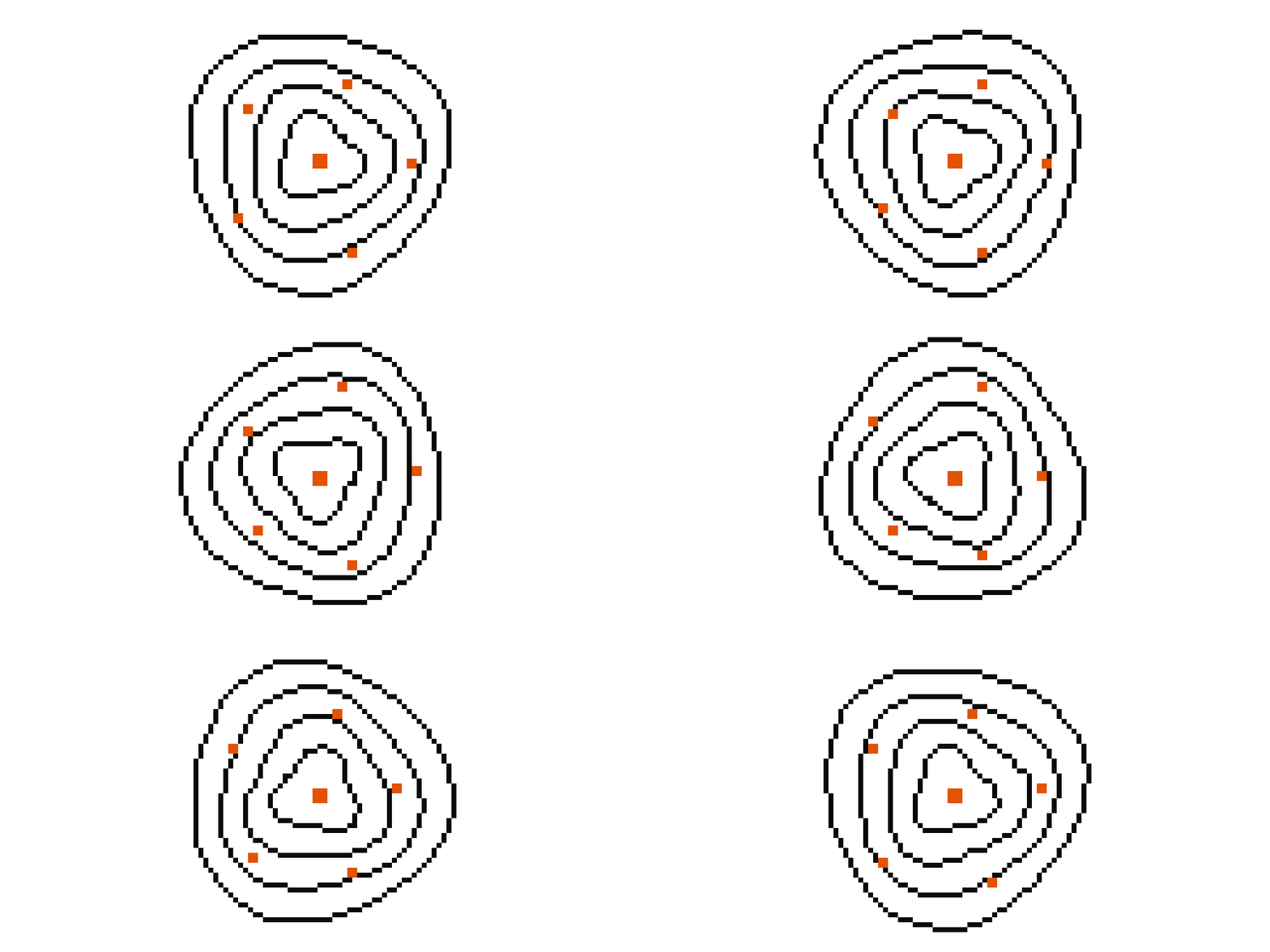
Design that ships as hardware.
Targets includes metamaterials, metasurfaces, photonic integrated circuits, quasi-crystalline lattices, nanolattices, phase change devices, adaptive structures, self-repairing composites, and wave calculation substrates.
Our system handles reverse design with physical constraints, differential simulation, multiphysics analysis, geometric generation, manufacturing tolerance analysis, and closed-loop calibration.
04 — Loop
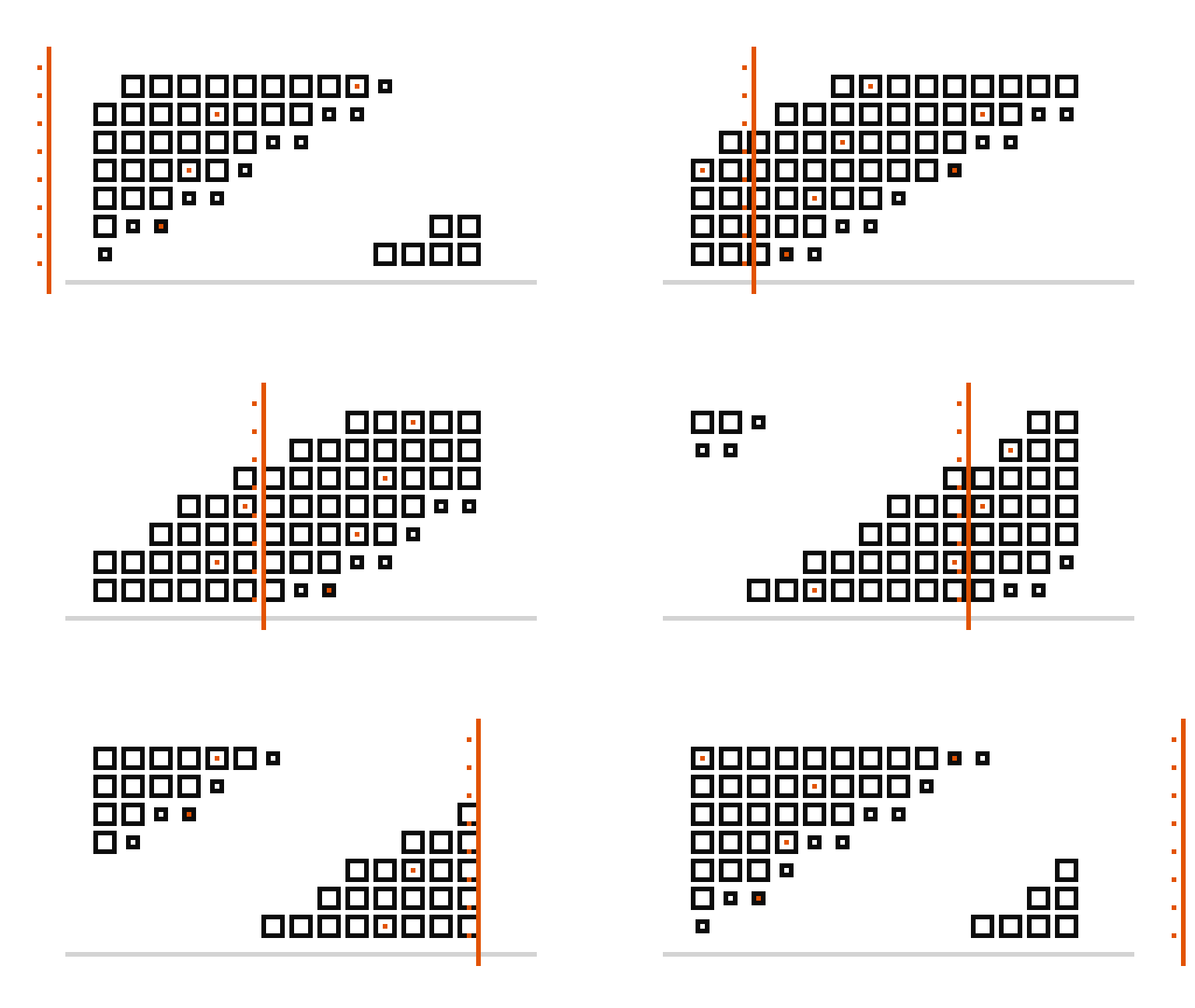
Simulation is not completion.
The design loop of Nanarch begins with the request specification. Next, define physical models, geometry, material candidates, and manufacturing constraints. The simulation results are converted into masks, GDS, circuits, processing diagrams, parts lists, and test pieces. The actual measured value is returned to the post-distribution, error model, and correction rule. The following design inherits the observation history.
Success in simulation does not mean completion.
If there is a lack of manufacturing potential, it is incomplete. Without a measurement plan, it is incomplete. If there is no comparison target, it is incomplete. If the failure condition is not defined, it is incomplete.
05 — Material
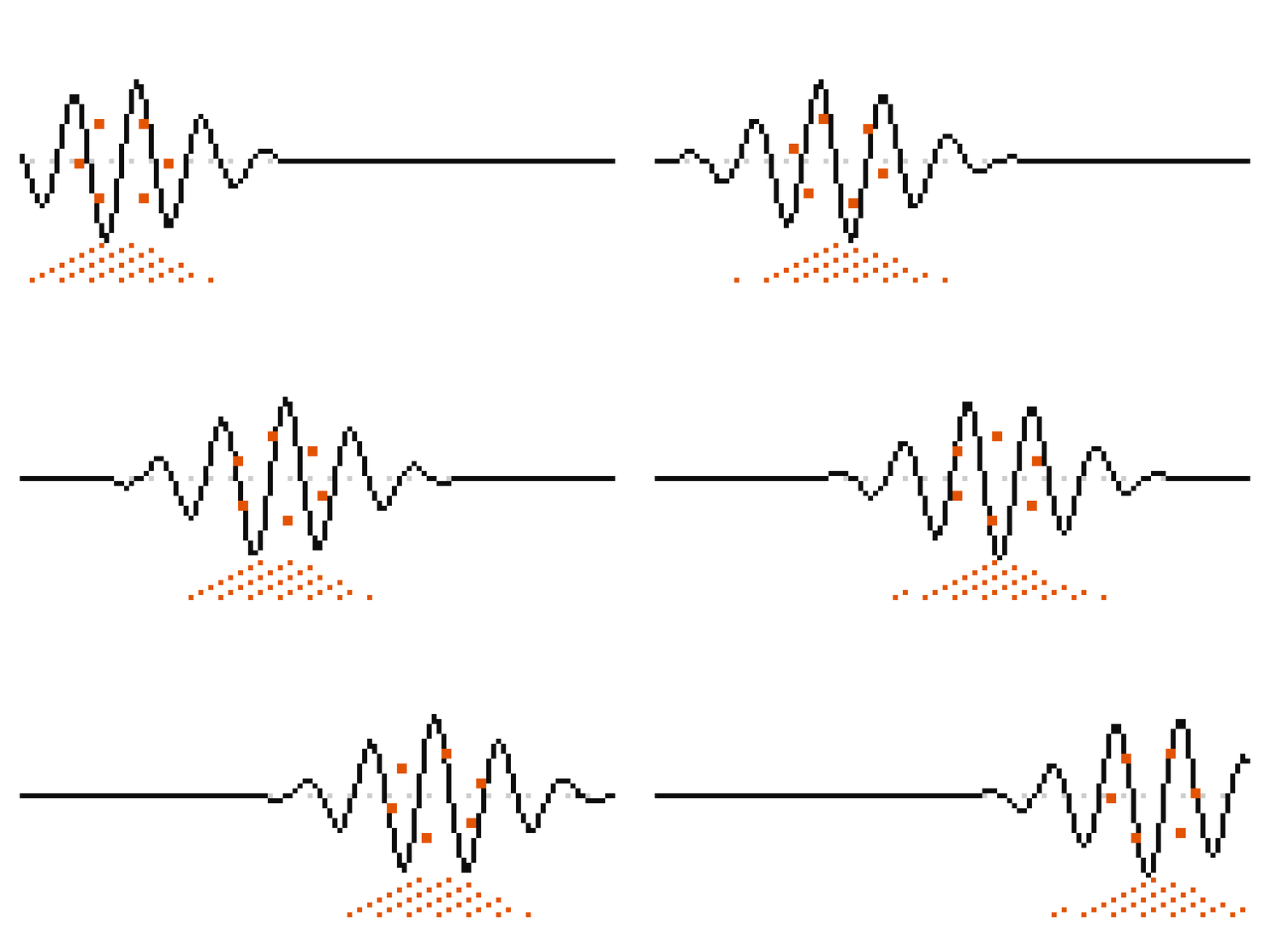
Material first.
Before initiating any cutting, a lapidary (gem cutter) carefully inspects the stone. This evaluation includes locating the polarization axis and determining how to orient the stone to avoid natural fracture directions. Inclusions may either be cut away as defects or intentionally incorporated into the optical design if they add unique visual effects. The choice of faceting pattern must account for reflection, light dispersion, extinction zones, and the risk of windowing (areas where light passes straight through without reflection).
The first cut sets the foundation and cannot be undone; errors here persist despite later polishing.
Ultimately, the lapidary’s role is not to impose an artificial form upon nature, but to reveal the latent structures already present within the material
Nanarch mirrors this design philosophy
06 — Route
Route over recipe.
Nanarch does not only design the completed state. Design the trajectory that leads there.
Temperature, pressure, electric field, magnetic field, light excitation, and chemical potential are treated as time-dependent control quantities. Rapid cooling, annealing, non-insulating quenching, and local phase boundary transfer are included in the calculation.
The spongy structure of the bone, the collagen orientation of the tendon, the helicoid layer of crustaceans, and the brick-like interface of the pearl layer are not strong as homogeneous materials.
Nanarch does not only optimize the composition of the material. The connection relationship, orientation, hierarchy, redundancy, and damage path are treated as design variables.
07 — Mechanism
Mechanism, not look.
A high-performance device is not a device with an excellent initial value. It is a device that can observe, correct, and maintain errors for a long time.
Evolution is not a complete designer. It is a search process that is bound by survival, reproduction, metabolism, and possibility of occurrence. The solution of the natural world is not the final answer. It is the initial condition for engineering exploration space.
The natural world is a design record established under limited elements, low-temperature manufacturing environments, local information, and slow growth rates. It is not the surface of the form that is valuable. It is a mechanism that generates functions.
Nanarch does not only evaluate momentary performance. Evaluate drift, deterioration over time, calibration frequency, synchronization error, control bandwidth, and recovery time.
08 — Company
Sharpen judgment.
It is not a company that absorbs knowledge into the central model and homogenizes it. It is a company that stores the knowledge of researchers, processors, designers, and customers inside the design system.
It is not intended to exclude human judgment from the process. Clarify where judgment is needed. Automate the work that can be delegated to the machine. Leave evidence and traceability for irreversible decisions.
Excellent tools do not make users mediocre. Sharpen observation skills, increase options, and increase the accuracy of intervention in the physical world.
Nanarch makes that kind of tool.
We are not interested in the future where software floats away from matter.
What we create is intelligence that comes into contact with reality, is corrected from reality, and functions within reality.
CompanyNanarch Technologies, Inc.
BaseNew York · Est. 2026
FocusMaterials science · artificial intelligence
Contactnanarchtech@gmail.com
System
Solver NominalContinuousThe Lattice Holds
Closed-Loop RegulationPhase-MatchedAutonomous Operation